

There are many challenges to safely navigating our ships and transporting their cargo through international shipping lanes and numerous ports. But perhaps one of the lesser-known obstacles is the bribery and corruption to which captains and crews can be subjected.
Stolt Tankers Managing Director, Maren Schroeder and Ian MacLean, master mariner and Partner, Hill Dickinson commercial law firm, discuss the risks, the laws designed to mitigate them and protect those affected, and why there has been a recent resurgence in incidents.
Stolt Tankers has announced its membership of the Maritime Anti-Corruption Network (MACN), which will see it working with MACN and likeminded industry players in the pursuit of a fairer maritime industry for the benefit of all.
Is corruption in the maritime world still an issue?
 Maren: Yes, very much so. I shared this note – which was presented to one of our captains by a port official a few weeks ago – on LinkedIn along with a message highlighting the issues that our captains are dealing with on a regular basis. The number of responses was overwhelming, suggesting that the shipping industry is far from where we want to be in this regard.
What was the outcome in the case of this note?
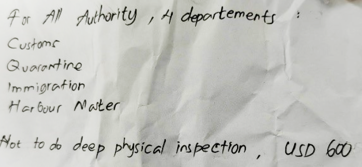 Maren: Our captain followed Stolt Tankers’ procedure and explained to the official that he was unable to provide cash or goods as he must abide by the law, specifically the UK Bribery Act 2010. He then reported the incident to his superintendent. In this instance, the captain received excellent support from our agent on site. No money or other payment of goods was paid and that ‘deep physical inspection’ never happened.
What does the UK Bribery Act 2010 involve?
 Ian: Legally, you will be guilty of bribery if you offer, promise or give any item of value – even cigarettes – to influence the actions of an official, or other person. This would be the case even if the official (including someone such as a tanker pilot) asks you for the ‘bribe’. It is enough that an advantage is gained, such as a pilot performing a service he might otherwise delay or perform more slowly.
Say a ship is waiting for a delivery of potable water. The agent advises that, owing to a ‘paperwork problem’, delivery will be the next day, delaying the vessel. However, the agent says he/she can persuade the clerk who issues the necessary permits to work late, but it’s customary to give them 200 cigarettes for extra effort. If the master then provides those cigarettes, that would be a bribe and a criminal offence would have been committed. If convicted of bribery, you can face up to a ten-year prison sentence and/or an unlimited fine.
And do other countries have similar laws?
Ian: Yes. The US, many EU states and Singapore, for example, have also enacted anti-bribery laws with heavy fines. The only safe course of action, irrespective of an individual’s nationality or the country they are in, is to refrain from bribery practices and advise the company if asked for a bribe.
So, what does this mean in practice for ship owners?
Maren: In the ’old days’ it was normal practice in shipping to hand out cigarettes or bottles of whiskey, for example, to a pilot to ensure a safe canal passage. For us, these days are long gone.
I must say that I had mixed feelings about this in the beginning. While I am against any form of corruption, I could also see the problems that would arise for our captains. Intentional groundings by disgruntled pilots were not unheard of; ships were unduly delayed or detained (and immediately put on hold by customers without asking questions) and occasionally ships were trashed by angry customs officials.
But it soon became well known that Stolt Tankers would not give anything (other than onboard hospitality –a coffee or a meal during a longer stay) and people soon stopped asking. Our captains reported that they were very happy with the new approach and that their lives became easier.
In 2021 we only had three demands for bribes reported, despite around 6,000 terminal calls during the year. However, in the post-pandemic world we have seen a change for the worse again.
How do you know whether it is a legitimate fine or detention or something that has been made up as part of a bribery attempt?
Ian: There are warning signs, such as only being advised about the fine verbally, where an official declines to submit the details of the fine to the agent, or if a payment is required in cash rather than to an official bank account. If you are in any doubt whatsoever, you should contact your employer for guidance.
What if a bribery threat is carried out?
Maren: If it all goes ‘wrong’, our ship might get detained. However, it does not happen often. In two years, we’ve had two undue detentions in a fleet of more than 160 ships. And, in both cases our customers listened to our side of the story, reviewed the evidence and did not put the ships on hold. And, in one case, with the help of our Flag State, we successfully appealed the detention, and it was deleted from the records. In my 20 years in shipping, I have never before seen a successful appeal!
But what happens if the captain and/or crew are in danger because they are not paying?
Ian: There is a general defense in law of ‘duress’ which it may be possible to rely upon. There are circumstances in which there is no alternative but to make payments to protect against loss of life, limb, or liberty. However, this does not apply to economic duress, so it would not apply where the bribe was to avoid delaying the ship.
In such circumstances you should attempt to have another person as a witness to the demands and any transfer of cash or ‘gifts’. You should then report what has occurred to the company/your employer as soon as it is safe to do so.
Do you think this is enough to reduce – and ideally eradicate – incidents of bribery in the maritime sector?
Maren: We are creatures of habit. If people keep giving ‘gifts’ or money, people will keep asking. Only if we collectively stop, can we make a difference.
Ian: I agree. We are seeing an increasing number of ship owners successfully refusing to provide gifts or make ‘facilitation payments’ to local officials and service providers. The evidence is that, in many ports, those who used to solicit bribes now understand that it is pointless trying to do so with ships operated by those companies that have a firm policy against the practice.