

Stolt Tank Containers (STC) runs a global fleet of 47,000 tank containers, safely moving everything from bulk liquid chemicals to food grade products door to door – whether those doors are in Brussels, Beijing or Brasilia.
STC has always been as zealously dedicated to ensuring all staff return home safely as it is to prioritising customer product safety. Global Head of Sustainability and Safety, Health, Environment and Quality (SSHEQ), Ilja Siebert explains how the company combines this historical commitment with technological innovation and a transparent culture to offer new levels of product protection, simplification of complex logistics and enhanced customer service.
By land and sea: global supply chain challenges
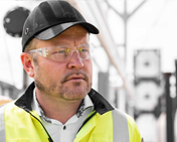 Although health and safety technology is advancing at an impressive pace, Siebert (pictured) emphasises that this area of business will always remain – first and foremost – people centric. “Health and safety is a vital pillar of our work,” he confirms. “At STC, we have 650 people across the world, working at 21 depots where, on a daily basis, we clean tanks, we prepare them for the next loading, and we heat products if needed – these can be volatile or regular, chemicals or food. We must make sure people go home safely. That’s our first priority.”
And the second fundamental function of STC’s health and safety team is ensuring that whenever and wherever products are transported, this is done as safely as possible in terms of protecting the environment and planet. “We don’t only transport products like milk: we also transport specialised products like hot chocolate,” says Siebert, “as well as sensitive products which must be handled carefully and correctly.”
“We have to make sure people go home safely. That’s our first priority.” – Ilja Siebert, Global Head of Sustainability and Safety, Health, Environment and Quality
Siebert has a team of SSHEQ managers in different global regions, helping him focus on local safety and sustainability issues in each location. And the third pillar of STC operations, he explains, is compliance. “With compliance, we ensure that the handling of tank containers and customers’ products adhere to local legislation at all stages. This can relate to volatile goods, food safety, or customs documentation.”
Certification is a key part of this planning and preparation. “We currently have 14 different types of certification,” Siebert explains. “We have ISO 9000, CDI MPC, QS Food Safety, ISO 22,000 and we’re now approaching the ISO 14000 certificate.”
But obtaining these industry-leading certifications is much more than a paper exercise. For STC, they’re the result of robust training and pinpoint procedures. “In order to get these certifications, we also need to make sure that our management system and the protocols behind it are correct and up to date,” says Siebert. “And people must be properly trained so that everything they do is safe, sound and in compliance with all the relevant industry and customer requirements.”
Netherlands-based van Gameren Transport BV is just one customer who appreciates STC's attention to detail. Founder and owner Patrick van Gameren, says: “We do all our tank cleaning and reheating at Stolt Tank Containers in Moerdijk because of their commitment to safety, their good communication and clarity around procedures.”
Holistic training
Running a complex, dynamic, global business safely requires staff in all roles to be trained in the ‘big picture’ of the business as well as the nuts and bolts of their specific role. This ensures that everyone is aware of their own responsibilities, the requirements of existing and new customers, and how all these factors fit neatly together.
One example of this is training sales staff. Siebert explains: “It starts with educating our commercial team not only to sell, but also to ask customers the right questions in relation to safety and the proper treatment and handling of their products. The mindset of sales employees isn’t just that they sell and generate quotes. They think about the impact of safety during product transport. And we have a team in the US that feeds this information into our global product database, making sure it’s accurate, up-to-date and traceable.”
“Our commercial team is trained not only to sell, but also to ask customers the right questions about product safety.” – Ilja Siebert
Meanwhile, a comprehensive onboarding process sets the tone for all new employees. “Depot office staff complete three weeks of training before they are allowed to start their core responsibilities,” says Siebert. “They’re trained on danger awareness, food safety, inhibited products and technical tank training. Office-based workers even go to the depot for a couple of days’ training, and we put them inside a tank to see how the cleaning process works.
“Following this, each employee receives a mix of online and classroom-based refresher training every year. They must sit exams and our online learning management system is checked to make sure all employees have the appropriate training to carry out all relevant tasks.”
Depot workers also have monthly toolbox meetings to ensure they’re aware of how to complete risk assessments and understand the PPE requirements and specific procedures for each job. And STC collaborates with customers to train office and depot staff on the specifics of transporting and handling sensitive products.
“For example, we recently transported a product called algal oil,” explains Siebert. “This product is very delicate – if you don’t treat it properly and ship it in a timely manner, it quickly spoils. So we trained all the staff in the depot and office on the exact transportation risks and requirements.”
Specialist technology
STC tank containers are cylindrical, typically hold 25,000 litres of product, fit in a frame to be transported by road and can also be carried on barges, trains and container ships. Because they can carry any liquid or gas, from heat-sensitive food products to more hazardous materials, they need to be carefully and thoroughly cleaned between jobs at each depot. Furthermore, with a separate global fleet of food-grade tanks, STC can ensure chemicals and food products are never transported in the same tanks.
And while the basic design of a tank container will probably remain similar for the foreseeable future, the systems and technology used to monitor and trace each tank (in a global fleet of 47,000 units) have become increasingly sophisticated.
“In order to properly handle, load and store products, it’s critical that the latest safety data sheet on any particular product is safely stored, available 24/7 and can be accessed globally,” Siebert explains. “Our Houston team enters the accurate information in the system, then comprehensive information on the correct handling of the product is sent automatically to depots worldwide.
“No one in our business has to manually send this information to vendors anymore – it’s all automatically transferred. This innovation improves safety because there’s less room for human error, caused by illegible handwriting or lost paperwork, for example.”
Parallel to this, GPS allows employees and customers to track and trace shipments 24/7. And while this gives customers peace of mind in terms of location and timelines, complex algorithms also interrogate the STC system constantly to monitor crucial metrics such as tank temperature and, in some cases, the chemical composition of time-sensitive product additives such as inhibitors.
Tangible results: culture and practice
An unwavering commitment to enhancing safe product handling through training and technology has cultural and practical benefits for STC.
Ever-improving staff awareness and expertise has led to more reporting, greater transparency and a refreshed commitment to health and safety organisation-wide. And gathering accurate, specific data on each product as early as possible enables the team to be better prepared and completely confident of delivering any type of material safely, anywhere in the world. “We know weeks, even sometimes months before, that a certain product will be transported,” Siebert says. “That’s why we’re capable of delivering world-class safe and sound transportation.”